
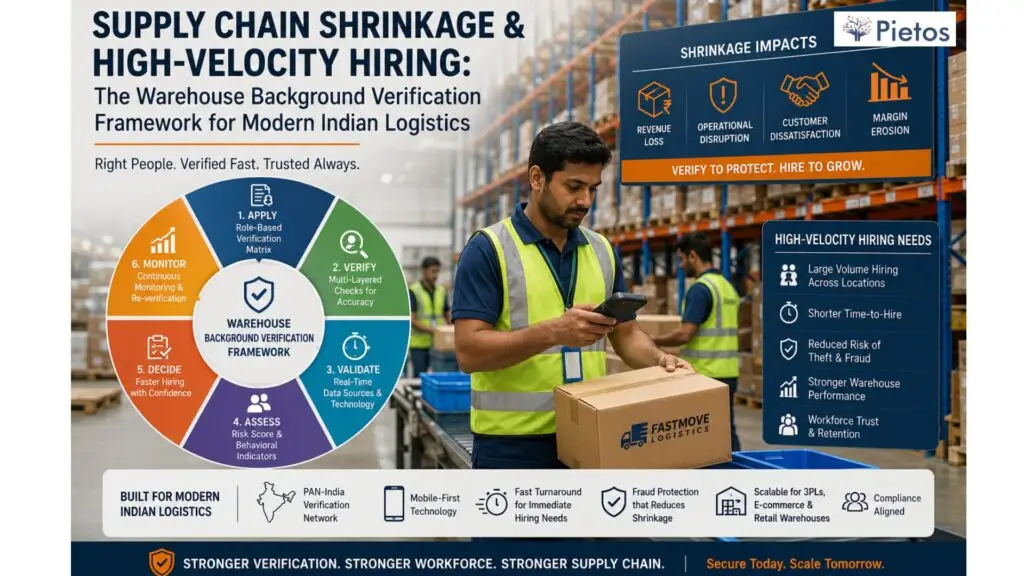
Implementing rigorous warehouse background checks in India has become an operational necessity for modern supply chains looking to protect margins and streamline fulfillment logistics. The explosive growth of quick-commerce, third-party logistics (3PL) providers, and micro-fulfillment centers has transformed quiet regions into hyper-active economic zones. Industrial corridors like Bhiwandi (Mumbai), Bilaspur (Delhi-NCR), Nelamangala (Bangalore), and Dankuni (Kolkata) now process millions of package movements daily.
Chapter 1: The Economics of Warehouse Shrinkage in India’s Logistics Corridors
The landscape of Indian logistics has undergone a massive structural shift. The explosive growth of quick-commerce, third-party logistics (3PL) providers, and micro-fulfillment centers has transformed quiet regions into hyper-active economic zones. Industrial corridors like Bhiwandi (Mumbai), Bilaspur (Delhi-NCR), Nelamangala (Bangalore), and Dankuni (Kolkata) now process millions of package movements daily.
However, this rapid scaling has exposed a critical vulnerability: systemic inventory shrinkage and internal pilferage.
For an enterprise supply chain, shrinkage is not just a rounding error, it is a direct drain on profitability. In high-volume distribution centers handling consumer electronics, pharmaceuticals, or high-value retail goods, inventory loss often traces back to internal networks. Organized cargo theft rings frequently place unvetted contractual workers into fulfillment hubs during peak hiring spikes. Without rigorous screening, a warehouse floor essentially operates on blind trust.
[Traditional Manual BGV: 7-14 Days] ──> Operational Bottlenecks & Ghost Attrition
[Pietos Automated API BGV: <24 Hrs] ──> Real-Time Onboarding & Fraud Prevention
The financial return on investment of a modern verification framework is directly tied to preventing these operational leaks. When a logistics hub experiences high turnover alongside inventory discrepancies, the root cause is rarely an failure of physical security cameras; it is a gap in workforce integrity.
To quantify the financial impact across different facility types, consider the operational risk matrix below:
The Logistics Vulnerability & Asset Risk Matrix
| Facility Typology | Primary Asset Risk Profile | Dominant Workforce Vulnerability | Financial Impact of Negligent Hiring |
| Mega Fulfillment Centers (100,000+ sq. ft.) | High-value electronics, cosmetics, white goods | High volume of seasonal contract loaders | High systematic leakage, bulk item diversion |
| Quick-Commerce Dark Stores (2,000–5,000 sq. ft.) | Hyper-local inventory, cash-on-delivery settlements | Rapid runner/picker turnover, synthetic identities | Wallet fraud, high daily inventory discrepancies |
| 3PL Multi-Tenant Hubs | Multi-brand cross-docking, high-security client goods | Interspersed third-party agency manpower | Cross-contamination of data, client contract breach |
When managing seasonal spikes in e-commerce fulfillment, relying on slow legacy vendors for warehouse background checks India operations causes catastrophic delivery bottlenecks. HR teams must transition to modern workflows, like those outlined in our comprehensive Mass Onboarding Logistics BGV Playbook, to properly balance operational speed with physical asset security.
Chapter 2: The Onboarding Bottleneck: Balancing Speed with Strict Security
The core operational challenge when executing warehouse background checks India workflows can be summarized in two words: Turnaround Time (TAT).
Logistics is inherently dependent on seasonal demand. During major peak periods like Diwali sales, regional festival spikes, or national shopping events, a single fulfillment center may need to onboard between 500 and 2,000 contract workers in less than 72 hours.
Traditional background verification models break down entirely under these conditions:
- The 7-Day Delay: If a traditional BGV vendor takes 7 to 10 business days to run manual address checks and criminal verifications, the hiring process stalls.
- The Attrition Loop: Blue-collar laborers will not wait a week for an onboarding clearance; they will simply cross the street to a competing warehouse that bypasses screening.
- The “Ghost Worker” Phenomenon: To meet immediate sorting and loading targets, facility managers are often forced to deploy unverified contract labor onto the floor, planning to run checks later. This creates an immediate security gap.
This operational friction leads to a dangerous cycle: companies compromise on security to maintain velocity, or they protect security but miss their fulfillment SLAs.
Furthermore, identity manipulation via image morphing or fabricated credentials remains a massive vulnerability in multi-tenant fulfillment centers. For a deep dive into mitigating advanced document forgery, review our complete guide on detecting a fake employment certificate in India.
                        [Candidate Submits Identity Data]
                                       │
                                       ▼
                       [Instant Pietos API Routing Bridge]
                        /              │
                       /               │
                      ▼                ▼                ▼
              [UIDAI Aadhaar]   [NCRB / e-Courts]   [EPFO Portal]
              Biometric/OTP      Criminal Check      UAN Activity
                                      │                /
                                      │               /
                        ▼              ▼              ▼
                     [Consolidated Integrity Scorecard Generated]
                                  (< 24 Hours)
To break this bottleneck, enterprise logistics firms are moving away from manual verification in favor of concurrent API-driven validation. By integrating background screening directly into the digital onboarding workflow, the initial compliance verification happens in real time while the worker is being briefed on safety protocols.When dealing with contract staff or supervisors working overlapping shifts across multiple third-party logistics providers, supply chain managers must also actively audit for concurrent payroll footprints. For an explicit breakdown on using APIs to isolate these compliance risks, read our analysis on Dual Employment Verification India: The 2026 HR Guide.
By deploying instant database lookups across government ID registries, litigation databases, and employment records, Pietos cuts down the timelines for warehouse background checks India by up to 80%. This allows logistics operations to onboard safely at scale without sacrificing speed.
Chapter 3: The 4-Tier Blueprint for Modern Warehouse Vetting
To secure high-volume fulfillment facilities without slowing down peak hiring seasons, operations teams cannot rely on a one-size-fits-all background screening model. A picker working a seasonal 30-day contract requires a different verification velocity than a warehouse manager handling inventory audits or high-value cross-docking assets.
An optimized warehouse workforce vetting architecture relies on a 4-Tier Verification Blueprint. This system layers real-time API queries with deep-source data extraction to create an un-compromised profile of every worker stepping onto the floor.
                  ┌────────────────────────────────────────┐
                  │ Candidate Onboarding Data Submission   │
                  └───────────────────┬────────────────────┘
                                      │
         ┌────────────────────────────┼────────────────────────────┐
         ▼                            ▼                            ▼
┌──────────────────┐        ┌──────────────────┐        ┌──────────────────┐
│  TIER 1: ID &    │        │ TIER 2: Criminal │        │ TIER 3: Past Work│
│  Biometric API   │        │ & Court Registry │        │ & EPFO Integrity │
└────────┬─────────┘        └────────┬─────────┘        └────────┬─────────┘
         │                           │                           │
         └───────────────────────────┼───────────────────────────┘
                                     │
                                     ▼
                  ┌────────────────────────────────────────┐
                  │ TIER 4: Automated Address Verification │
                  └────────────────────────────────────────┘
Tier 1: Real-Time Identity & Biometric Verification
The foundation of warehouse floor security rests on establishing absolute identity integrity. In high-volume hiring environments, candidates frequently submit altered documents, masked identity numbers, or credentials belonging to family members to bypass active blacklists.
Modern enterprise systems use automated bridges to query the Unique Identification Authority of India (UIDAI) and national tax registries instantly.
- Aadhaar & PAN API Validation: Extracts data straight from the primary government source, bypassing uploaded physical paper trail manipulation.
- Face-Match and Liveness Detection: Compares a live smartphone selfie or onboarding kiosk snapshot against the encrypted UIDAI photo registry. This prevents synthetic identity creation and stops proxy candidates from slipping through.
Tier 2: Real-Time Court Record & Litigation Scraping
In logistics hubs, checking for a history of property damage, cargo diversion, or violent behavior is a key requirement for negligent hiring defense. Manual police verifications in India can take up to 21 days depending on regional jurisdictions, which doesn’t work for agile supply chains.
To solve this, programmatic engines run direct queries against the National e-Courts District and High Court Registries. By indexing millions of legal files using advanced phonetic matching algorithms, the system flags active charges for financial fraud, theft, or assault in under 24 hours.
Tier 3: Employment and Financial Integrity Vetting
A major risk for fulfillment centers is when candidates use fake experience certificates to qualify for specialized roles like inventory clerks or shift leads.
To mitigate this, automated background checks leverage direct-to-source APIs. For example, querying the Employees’ Provident Fund Organisation (EPFO) database via a candidate’s Universal Account Number (UAN) reveals their actual employment timeline and previous company exits instantly.
This step also detects if a candidate is working multiple overlapping shifts simultaneously. To understand how automated database queries flag hidden secondary payrolls, review our detailed guide on Dual Employment Verification India: The 2026 HR Guide.
Tier 4: Digital Address Stability Verification
Logistics networks employ a highly mobile, frequently shifting workforce. If an internal security incident occurs, having a fake or outdated address on file can stall recovery efforts.
Modern screening frameworks combine traditional verification with digital validation tools:
- Geo-Coordinates Extraction: Candidates drop a pin at their current residence via a secure link, recording exact latitude and longitude coordinates.
- On-Ground Verification Networks: For high-stakes or permanent placements, automated coordinate tracking is backed by localized field verification apps, ensuring rapid validation.
Ensuring that your warehouse background checks India protocols feature localized field verification apps alongside coordinate tracking provides rapid validation. To see how substituting manual field checks with automated technology cuts turnaround times down to hours, read our analysis on Digital BGV vs Physical Checks: Cutting Turnaround Time by 40%.
Chapter 4: Forklift & Heavy Equipment Operators: Managing Liability on the Floor
While standard sorting and packing roles require rapid identity and criminal checks, specialized heavy equipment operators—such as forklift drivers, reach truck operators, and yard management teams—introduce a different level of operational risk.
[Unverified Operator Placement] ──> Warehouse Accident ──> OSHA/Legal Penalties + Supply Chain Standstill
An unvetted, unlicensed, or poorly trained operator handling a heavy reach truck in narrow high-bay racking systems can cause massive inventory loss, workplace accidents, and costly legal liabilities.
The Technical Vetting Framework for Material Handling Equipment (MHE) Staff
| Operator Classification | Primary Verification Requirement | Target Database Endpoint | Critical Risk Mitigated |
| Forklift & Reach Truck Drivers | Commercial Heavy Motor Vehicle (HMV) License Authentication | MoRTH VAHAN / SARATHI API | Racking collapses, vehicle collisions, property damage |
| Yard Managers / Hostler Drivers | Commercial Driving History & Past Traffic Violations | Regional Transport Office (RTO) Infraction Registries | Cargo tipping, gate congestion liability, vehicular accidents |
| Cold Storage Equipment Operators | Certified Technical Competency & Health Vetting | Specialized Vocational Institutions / Medical Boards | Thermal damage, improper hazardous material handling |
When an enterprise hires heavy equipment operators at scale, checking physical paper licenses is no longer enough. Sophisticated document forgery allows unlicensed individuals to secure high-paying machinery roles.
To counter this, modern logistics platforms connect directly to the Ministry of Road Transport and Highways (MoRTH) through secure VAHAN and SARATHI API integration hubs.
When an applicant enters their driving license details, the platform immediately extracts data from the central government clearinghouse:
- Validates the exact license class (ensuring authorization for Commercial HMV/Trans, not just private light motor vehicles).
- Verifies the license expiry status and active blacklisting flags across all Regional Transport Offices (RTOs) in India.
- Confirms identity alignment by cross-referencing the license name directly with UIDAI records.
Ensuring your machine operators are fully licensed and compliant is critical for protecting physical inventory. It also safeguards your business from having claims denied by commercial insurance providers due to negligent hiring.
Furthermore, because background check engines use real-time automation to run these checks alongside identity validations, your logistics team can scale specialized personnel quickly during seasonal spikes without compromising safety protocols.Ensuring your machine operators are fully licensed and compliant is critical for protecting physical inventory. Because background check engines use real-time automation to run these checks alongside identity validations, scaling your warehouse background checks India process allows your logistics team to grow specialized personnel quickly during seasonal spikes without compromising safety protocols. To learn more about optimizing automated checks across complex supply chain networks, look over the frameworks outlined in our Mass Onboarding Logistics BGV Playbook.
Chapter 5: Navigating the DPDP Act in Blue-Collar Labor Management
As supply chains digitize their hiring pipelines, they must navigate a shifting regulatory landscape. The implementation of the Digital Personal Data Protection (DPDP) Act has fundamentally changed how companies collect, store, and process candidate information during background checks in India.
Historically, blue-collar hiring involved collecting unencrypted photocopies of Aadhaar cards, PAN cards, and bank details, which were often left exposed in regional warehouse offices or shared via unsecure messaging apps. Under the DPDP Act, this practice carries significant compliance and financial risks.
[Unprotected Paper Copies/WhatsApp Data] ──> Data Leak ──> Severe DPDP Non-Compliance Penalties
[Pietos Consent-First Encrypted API Hub]  ──> Data Vaulted ──> Full Regulatory Audit Clearance
The DPDP Act establishes strict guidelines for data collection that apply equally to corporate executives and seasonal contract workers:
- Explicit, Purpose-Specific Consent: Consent cannot be buried in long, complex employment contracts. It must be requested through a clear, standalone notice available in languages the candidate understands.
- The Right to Erasure: Once a seasonal contract ends and the verification audit is complete, candidates have the legal right to request the deletion of their personal data, unless retention is mandated by other labor laws.
- Data Fiduciary Accountability: Enterprise logistics firms are classified as “Data Fiduciaries.” If a third-party manpower vendor leaks candidate data, the parent enterprise remains legally liable for the breach.
Managing data privacy for a workforce that may have limited digital literacy or lack personal email accounts requires a shift in how data is collected.
To solve this, modern background verification systems use localized, mobile-first consent engines.
Instead of requiring candidates to navigate complex online forms, the system sends an automated, multilingual consent prompt via popular channels like WhatsApp or interactive SMS. The worker can review the data request in their native language and provide legally valid consent with a simple tap.
Behind the scenes, the data moves through encrypted API channels directly to secure verification databases, eliminating the need to store physical paper documents at the warehouse facility.
Managing data privacy for a workforce that may have limited digital literacy requires a shift in how data is collected. Maintaining strict data privacy protocols while scaling warehouse background checks India pipelines is no longer just a compliance box to tick; it is a core operational requirement. To learn more about aligning your internal hiring systems with India’s data laws, look over our comprehensive guide on Dual Employment Verification India: The 2026 HR Guide.
Chapter 6: Managing the Third-Party Staffing (3PL) Risk Loop
A significant vulnerability for enterprise logistics hubs stems from outsourcing hiring to third-party manpower agencies and contract vendors.
While relying on 3PL providers helps operations teams scale up quickly during peak seasons, it often creates a major blind spot in security and compliance.
Many manpower agencies face pressure to meet aggressive staffing quotas within tight timelines. As a result, they may cut corners on background checks, rely on unverified self-declarations from candidates, or fail to flag individuals with histories of workplace misconduct.
To mitigate this risk, enterprise supply chains should implement a Vendor-Managed Vetting Framework. This strategy shifts the responsibility of running verifications onto the staffing vendor while allowing the parent enterprise to retain full control over compliance standards through a centralized screening platform.
To enforce these security standards effectively across all third-party staffing partners, procurement and HR teams can integrate the following copy-and-paste Service Level Agreement (SLA) framework into their vendor contracts:
📋 Standard Operating Clause: Workforce Integrity and Vetting Mandate
1. Scope of Verification: The Supplier (Manpower Agency/3PL Provider) agrees that no contractual, temporary, or permanent personnel shall be deployed onto the Buyer’s warehouse premises without successfully passing a multi-layered digital background verification. This verification must be executed through the Buyer’s designated automated provider (Pietos).
2. Mandatory Screening Modules: Every deployed profile must contain verified records for the following three areas:
- Identity Authentication: Direct database validation of Aadhaar and PAN records accompanied by live face-matching analysis.
- Criminal Records Search: Automated phonetic cross-referencing against the National e-Courts district and high court registries.
- Prior Employment Audit: Direct validation of employment history via UAN/EPFO database lookups to identify hidden secondary payrolls.
3. Turnaround Time (TAT) Thresholds: The Supplier must ensure all Tier-1 and Tier-2 automated verification checks are completed and scored within 48 hours of the candidate submitting their onboarding details.
4. Compliance Auditing: The Buyer reserves the right to conduct unannounced digital audits of the Supplier’s personnel portal. Any instance of an unverified worker operating on the facility floor will result in an immediate financial penalty of INR [X,000] per violation and may lead to the suspension of the vendor contract.
By formalizing these compliance requirements in vendor contracts, enterprise logistics firms ensure their third-party staffing partners adhere to the same rigorous screening standards as internal hires.
This centralized approach helps prevent unverified contract personnel from entering the facility, protecting inventory security and operational stability.
To see how automated, multi-vendor screening architectures help secure high-volume fulfillment environments, read through the practical case studies in our Mass Onboarding Logistics BGV Playbook.
Chapter 7: The Master Warehouse Screening Matrix
| Warehouse Role | Mandatory Verification Suite | Critical Database Endpoints | Target SLA Turnaround Time (TAT) | Primary Risk Mitigated |
|---|---|---|---|---|
| Loader / Picker / Packer | Identity Validation + Global Sanctions List + Basic Court Search | UIDAI (Aadhaar), Central PAN Registry, National e-Courts Database | < 4 Hours (Instant API) | Identity fraud, proxy hiring, historical track record check |
| Forklift / MHE Operator | Commercial Driving License Authentication + Face-Match Verification | MoRTH (VAHAN & SARATHI Registries), Regional Transport Offices | < 12 Hours | Facility property damage, racking collapses, unlicensed operating |
| Inventory Audit Clerk | Dual Employment Check + Prior Experience Tracking + Comprehensive Court Search | EPFO Database (UAN History Tracking), Corporate HR Repositories | < 24 Hours | Internal data manipulation, stock sheet fraud, concurrent payroll loops |
| Shift Supervisor / Manager | Comprehensive Financial Integrity Check + Past Work Verification + Complete Legal Audit | Indian Banking Bureau Data, Past Employers, State/District Judiciary | 24 to 48 Hours | Vendor kickbacks, systematic inventory diversion, high-level compliance gaps |
| Delivery Executive / Runner | Instant KYC Profile + Active Driving License Scan + Face-Match Check | DL Central Repository, Digital Geo-Coordinate Address Dropping | Real-Time API Hook | Cash-on-delivery (COD) settlement flight, last-mile parcel leakage |
Conclusion: Future-Proofing Supply Chain Trust with Pietos
As e-commerce volume and supply chain footprints grow across India’s premier industrial corridors, traditional, slow background check models are no longer sufficient. Modern logistics infrastructure requires verification systems that scale fluidly alongside seasonal demand.
By integrating instant, API-driven database checks directly into your onboarding pipeline, your operation can eliminate the traditional 7-day hiring delay. This approach protects your margins from inventory shrinkage, secures physical facility assets, and ensures full compliance with modern data legislation.
Don’t let manual onboarding processes slow down your distribution center’s velocity. Contact the Pietos Enterprise Screening Team today to discover how our automated API platform can future-proof your high-volume hiring workflows.




Pingback: BGV Candidate Ghosting: How Slow Checks Cost You Hires - Best Background Verification Company in India | Pietos