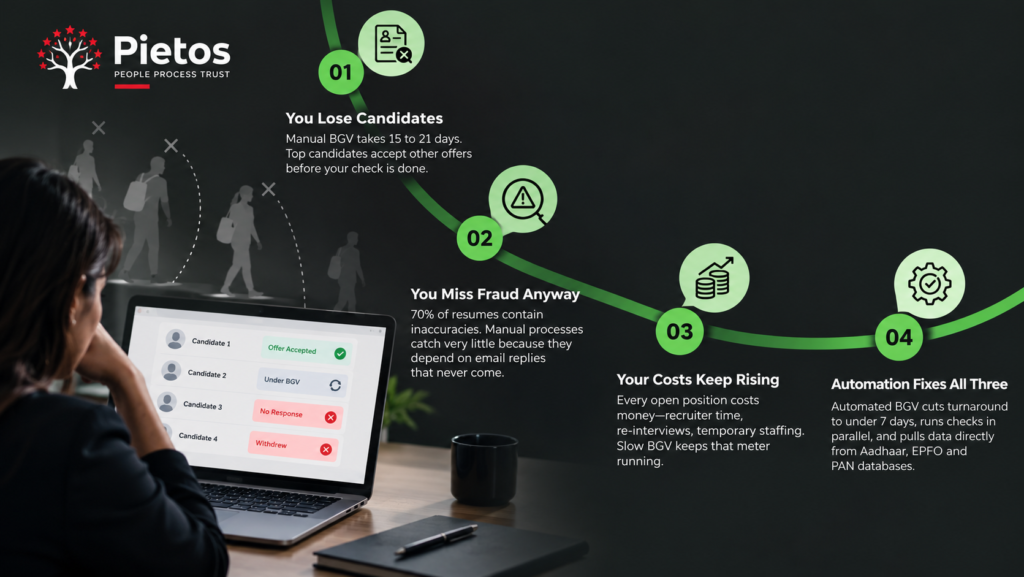
BGV candidate ghosting is the quiet hiring problem that costs Indian employers their best people. A candidate accepts your offer on Monday. Your background verification starts on Tuesday. Then days pass with no update. Meanwhile, a faster employer sends another offer. By Friday, your candidate has stopped replying.
This guide explains why BGV candidate ghosting happens and what it costs you. It also shows how faster checks, clear updates, and a smarter process keep candidates engaged. In addition, you will get a five-touchpoint framework you can start using this month.
Pietos built its process around speed. Its digital checks average 48 hours. Read on to see how that compares with your current process.
Not sure where your verification speed stands? Request a free turnaround benchmark from Pietos and compare it with your current vendor.
Why BGV Candidate Ghosting Is Rising in India
Hiring in India already moves slowly. According to The Peoples Board’s 2026 hiring guide, average time-to-hire sits at 35 to 45 days. Notice periods then add more weeks. As a result, candidates wait a long time before their first day.
Background verification sits inside that wait. Most employers launch checks after the candidate accepts the offer. Therefore, the candidate hears little for days. Meanwhile, the notice period clock keeps ticking, and doubt grows.
Hiring Timelines Stretch While Patience Shrinks
Candidates compare employers in real time. They notice who replies fast. They also notice who goes quiet. In fact, Qureos lists poor communication and long hiring timelines among the main causes of ghosting in India.
Think about the candidate’s position. They have resigned, or they are about to. They have told family and friends about the new job. Then your verification stalls. Because of this, any new offer looks safer than waiting for yours.
AI Tools Changed How Candidates Apply
GPT-6 Astra has changed the application game. Candidates can now send personalised applications to 50 or more jobs at once. Consequently, many candidates hold several live options at the same time.
The Peoples Board reports that recruiters who once saw 50 applications per role now see 400 or more. Candidates, in turn, juggle many replies at once. So your offer is rarely the only one on the table.
Furthermore, the next offer letter often arrives while your verification still runs. Patience for slow BGV has dropped sharply as a result.
What the Data Says About Ghosting and Dropped Offers
Hiring data across India points the same way. Candidates disappear often. They disappear most between offer and joining. The table below pulls together the latest figures.
| Finding | Figure | Source |
|---|---|---|
| Indian recruiters who report candidates disappearing | 76% | The Peoples Board |
| Recruiters who say ghosting happens more often now | 57% | The Peoples Board |
| Candidates who admit ghosting after accepting an offer | 44% | AceNgage |
| Offer acceptance rate in Q2 2025 (down from 74% in Q2 2023) | 51% | AceNgage |
| Candidates who decline offers after a poor hiring experience | 52% | BW People, citing Codegnan |
These figures cover hiring in general. They do not isolate BGV. Even so, verification sits inside the riskiest stretch. The Hire Hub reports that the offer-to-joining window averages 42 days in Indian hiring. It also calls that window the single highest-risk period for ghosting.
For wider benchmarks, explore SHRM’s workforce research, LinkedIn Talent Solutions, and NASSCOM’s IT-sector insights. Each offers context on hiring speed and candidate behaviour.
Key takeaways
- Ghosting peaks after the offer, when BGV usually runs.
- Weak communication and long timelines drive candidates away.
- Most Indian recruiters have already lost candidates this way.
BGV Candidate Ghosting Starts With a Time Gap
Compare two clocks. The first clock is your hiring cycle. The second clock is your verification. When the second clock runs long, candidates leave.
Many employers accept slow verification as normal. However, the gap is large. Industry guides cite three to ten working days for standard checks in India. Field-based checks run longer. Pietos’ own benchmarks show physical-only checks taking 7 to 15 business days. Manual police verification can stretch to 21 days.
So BGV can add 7 to 21 days to a 35 to 45 day hiring cycle. That is roughly 15% to 60% more waiting. In short, every extra day hands a competitor another chance.
| Check route | Typical time | Risk of silent drop-off (our assessment) |
|---|---|---|
| Digital identity and employment checks | Instant to 2 business days | Low |
| Hybrid (digital plus selective field checks) | 5 to 12 business days | Medium |
| Physical-only and police checks | 7 to 15 business days, up to 21 | High |
Pietos published the first two timelines in its digital vs physical BGV comparison.
The Psychology Behind BGV Candidate Ghosting
BGV candidate ghosting is rarely about bad manners. It is about fear, uncertainty, and options. Understanding that helps you fix it.
Why Silence Feels Safer Than Rejection
Most candidates do not want to hurt you. However, they avoid hard conversations. Telling an employer “I am leaving the process” feels awkward. It also feels risky if they still need a backup plan. Silence is easier.
Candidates also read your silence as a signal. If you send no updates, they assume trouble. Perhaps the check found something. Perhaps the offer is shaky. Therefore, they protect themselves and stop engaging.
How Missing Updates Drive the Behaviour
Verification asks a lot of candidates. They upload documents, give consent, and share past employer details. Many also worry that their current boss will hear about the move. Without updates, these worries grow fast.
Four triggers show up again and again:
- No confirmation after the candidate gives consent
- Repeated requests for the same document
- Unexpected calls to former employers
- No clear end date for the process
Each trigger adds friction. As a result, candidates start to ask whether the job is worth the hassle.
Where Drop-Off Risk Clusters
Published data on drop-off by BGV day is thin. Still, HR teams describe three danger zones. Treat them as patterns to test in your own data, not as fixed statistics.
- Day 1 to 2 after consent. The candidate hears nothing and feels ignored.
- Days 4 to 7. Document gaps and field-visit scheduling create friction.
- The final week before joining. No clearance and no confirmed date leave the candidate exposed.
Pull your own numbers. Count how many candidates vanish in each window. That baseline will guide every fix later in this guide.
Want to see where your candidates drop off? Talk to Pietos about a BGV process review and map your risk windows before the next hiring cycle.
The Real Cost of a Ghosted BGV
A ghosted BGV costs more than a lost candidate. It resets your whole hiring clock. Moreover, talent is scarce. Qureos’s latest hiring trends report notes that 82% of employers struggle to find skilled talent. Each lost candidate therefore hurts more.
Direct Costs
- Wasted verification spend. Pietos puts a standard corporate package at ₹1,200 to ₹3,000 per candidate. You may pay for checks already run on someone who never joins.
- Replacement cost. The Peoples Board lists cost-per-hire at ₹1.5 to ₹3.5 lakh for mid-senior roles. A replacement search repeats much of that spend.
- Re-screening. The next candidate starts the same verification clock from zero.
Hidden Costs
- Delayed project starts. One India hiring playbook estimates ₹67,000 to ₹1 lakh in lost productivity per role across a 42-day cycle.
- Recruiter burnout. Your team chases the same role twice.
- Client risk. Staffing and services firms miss start dates promised to clients.
- Weaker employer brand. Candidates share bad experiences, and the next shortlist gets harder.
The Cost of Inaction
Here is an illustrative example. Suppose you make 20 offers a month. Suppose 4 candidates ghost during BGV. You restart 4 searches. At the low end of ₹1.5 lakh each, that costs ₹6 lakh every month. Over a year, the loss passes ₹70 lakh.
Your numbers will differ. However, the pattern holds. Slow verification is not a free cost of hiring. It is a recurring leak.
BGV Speed Benchmarks: What Fast Actually Looks Like
Speed claims are easy to make. Real benchmarks are harder to find. The table below compares legacy routes with digital routes, using timelines Pietos has published.
| Check | Legacy route | Digital route |
|---|---|---|
| Identity | About 48 hours | Near-instant |
| Education | Up to 14 days (postal and email) | 48 to 72 hours (institution APIs) |
| Employment history | Days of email follow-up | Same day for UAN-linked history |
| Address | 7 to 15 business days (field visit) | Hours (a logistics playbook targets 4) |
| Full digital package | 3 to 7 business days | Under 48 hours |
Sources: Pietos’ enterprise verification guide, India Stack BGV post, and logistics BGV playbook.
Notice the pattern. Digital checks finish in hours. Field checks take days. Therefore, the fastest process sends every possible check down the digital route first. Then it adds field visits only where risk demands them.
This is also where digital background verification in India pays off. Pietos reports that digital-first employers cut turnaround by 38% to 42% against legacy providers. Faster results mean fewer silent weeks for your candidate.
Key takeaway: Speed is not a rush job. It is a routing decision. Digital first, field second.
Five Touchpoints That Reduce BGV Candidate Ghosting
Speed fixes half the problem. Communication fixes the other half. Use the five touchpoints below to keep candidates engaged from consent to day one.
Set a clear goal. Aim to cut BGV-stage drop-offs by 40% or more. Measure your baseline first, so you can prove the gain.
Touchpoint 1: Confirm Consent Within Hours
Send a confirmation the same day the candidate gives consent. Say what you will check, why, and how long it takes. Also explain who sees the data. Clear answers calm early doubts.
Touchpoint 2: Share One Document Checklist
Ask for every document once. Give a simple checklist with examples. In addition, offer a way to upload from a phone. Repeated requests are a top reason candidates lose patience.
Touchpoint 3: Send a Progress Update at 48 Hours
Tell candidates what is done and what is pending. Even a short message works. For instance, “Identity and education are clear. Employment is in progress.” Progress proves the process is moving.
Touchpoint 4: Call Before You Email About Issues
If a check finds a gap or mismatch, call the candidate first. Explain the issue and the fix window. Many gaps have simple causes, such as a name spelling. A friendly call prevents panic.
Touchpoint 5: Confirm Clearance and Stay Warm Until Day One
Send clearance news the moment it arrives. Then confirm the joining date. After that, keep in touch. The Hire Hub suggests a short weekly check-in between signature and start date. Even two lines help.
Redesign Your HR Process: Run BGV in Parallel
Touchpoints help. A better process helps more. Many employers still run BGV in a straight line. Offer, acceptance, resignation, then verification. That order wastes weeks.
Start BGV During the Notice Period
Launch checks as soon as the candidate accepts and gives consent. Do not wait for the relieving letter. Pietos’ gig-economy onboarding report contrasts sequential and parallel workflows. Parallel flows save turnaround time.
One caution applies. Always get written consent first. Also avoid contacting the current employer without the candidate’s approval. This keeps you inside India’s DPDP rules and protects trust.
Split Checks Into Fast and Slow Lanes
Not every check needs the same speed. Create two lanes:
- Fast lane: identity, education, UAN-based employment. Target 48 hours.
- Slow lane: court records and physical address. Run these in parallel, not after.
For lower-risk roles, you can clear the fast lane and confirm joining. Then you close the slow lane in the first weeks. Set this rule in your hiring policy, with risk-based exceptions.
Set SLAs and Track Drop-Offs
Write turnaround targets into your vendor contract. Pietos’ India Stack guide suggests same-day commitments for education, identity, and employment checks. It also suggests a longer, separate SLA for address and court checks.
Then track three numbers every month: average turnaround, insufficiency closure time, and drop-off by BGV day.
Decide: In-House or Specialist Vendor?
Small in-house teams can manage occasional checks. However, volume exposes the gaps. Pietos’ in-house vs outsourced BGV comparison shows the trade-offs.
| Factor | In-house team | Specialist BGV vendor |
|---|---|---|
| Tooling and data access | Often limited | Built for scale |
| Legal defensibility | Depends on internal expertise | Documented verification trail |
| Cost per verification | Hidden in HR time | Transparent, per-check pricing |
For public-sector hiring, Pietos adds that internal teams sized for hundreds of checks struggle with thousands. The gap then shows up as delay, not failure. The same logic applies to any hiring surge.
How a Real-Time Status Portal Reduces Candidate Anxiety
A status portal turns silence into information. Candidates see which checks are done, which are pending, and what comes next. As a result, they stop guessing.
Pietos’ real-time candidate status portal works on three ideas:
- Visibility. Candidates and HR see the same check-by-check view.
- Consent control. Pietos’ instant verification guide describes a consent dashboard. It halts pending checks if a candidate withdraws.
- Exception-based follow-up. Recruiters step in only when the system flags a serious discrepancy.
The need is real. Pietos documented an IT engineering firm that, before integration, faced a 9-business-day onboarding delay and a 34% candidate drop-off rate. That is exactly the pattern this guide describes.
Because Pietos also runs a field network, it covers tier 2 and tier 3 cities where digital records fall short. Its address verification guide explains how hybrid checks keep timelines realistic.
Buyer Objections, Answered
HR and finance leaders raise the same doubts. Here are honest answers.
“Faster BGV means weaker checks.” Not so. Better process design cuts delay, not depth. Pietos explains this in its turnaround time guide. The checks stay the same. The waiting disappears.
“Faster will cost more.” Speed comes from automation, not rush fees. Review the BGV cost guide for ranges by check type. Also note that The Peoples Board highlights Pietos for publicly disclosing per-case pricing.
“Our HR team already handles this.” Internal teams work well at low volume. However, ghosting data shows the cost of delay is high. Compare your drop-off rate against the figures above.
“Candidates will not use a portal.” Candidates already use apps for everything. A mobile-friendly flow with consent links is easier than email chains.
“Switching vendors is risky.” Start small. Pietos suggests comparing turnaround and report quality on a pilot batch before you commit fully.
Trust Signals to Check Before You Switch
Ask every vendor the same questions. Here is what Pietos states publicly:
- 500,000+ background verifications completed across blue-collar, gig, BFSI, and enterprise hiring
- ISO 27001 and SOC 2 Type II certification
- Consent-first workflows aligned with the DPDP Act
- Publicly disclosed per-case pricing
- Digital checks plus a pan-India field network
For a wider view, read Pietos’ guide to the top background check tools in India. It compares four vetting frameworks, not only Pietos.
Your 30-Day Plan to Cut BGV Candidate Ghosting
- Week 1: Measure. Count drop-offs by BGV day. Record average turnaround.
- Week 2: Map. List every message a candidate gets. Add the five touchpoints.
- Week 3: Parallelise. Launch BGV right after consent. Split fast and slow lanes.
- Week 4: Pilot. Run a small batch with a faster vendor. Compare turnaround and drop-off.
After 30 days, you will know your real ghosting cost. You will also know which fix pays back first.
Conclusion: Stop BGV Candidate Ghosting Before It Starts
BGV candidate ghosting is not a candidate problem. It is a process problem. Slow checks, silent gaps, and sequential workflows push good people away. Meanwhile, tools like GPT-6 Astra give candidates more options than ever.
The fix is clear. Route checks digital first. Run BGV in parallel. Send five timely updates. Track drop-offs by day. Then choose a partner built for speed.
Your BGV is costing you candidates. Pietos’ average TAT is 48 hours for digital checks. See how it compares to what you are doing now, or reach the team at contact@pietos.com or +91 11 49074103.
Related Resources
| Anchor text | Destination | Why it helps |
|---|---|---|
| Background verification TAT India | pietos.com/background-verification-turnaround-time/ | Sister post on TAT. The cross-link is essential. |
| Digital background verification India | pietos.com/digital-background-verification-india/ | Digital BGV solves the speed problem. |
| BGV cost in India 2026 | pietos.com/background-verification-cost-india/ | Shows faster BGV does not mean costlier BGV. |
| Instant verification guide Pietos | pietos.com/the-ultimate-guide-to-instant-verification-accelerating-trust-with-pietos/ | Pietos’ own capability page on rapid verification. |
| In-house vs outsourced BGV | pietos.com/moonlighting-declaration-verification-bgv-india/ | Contains the in-house vs vendor comparison. Swap when a dedicated post goes live. |
Trusted External Sources
- Hiring in India 2026 guide, The Peoples Board: time-to-hire benchmarks
- LinkedIn Talent Solutions: platform hiring insights
- NASSCOM: India IT-sector hiring context
- Qureos hiring trends in India: 2026 hiring and candidate behaviour trends
- SHRM: global hiring benchmarks
Frequently Asked Questions
BGV candidate ghosting happens when a candidate stops replying during background verification. It often follows a signed offer. Slow checks and missing updates are the usual triggers.
Standard checks take 3 to 10 working days across the industry. Field-heavy checks can take 7 to 21 days. Pietos’ digital checks average 48 hours.
No. Faster BGV comes from better routing and automation. The same checks run through direct digital sources, with field visits added where risk requires them.
Yes, with written consent. Start right after acceptance. Avoid contacting the current employer without the candidate’s approval, and follow DPDP consent rules.
Send five updates: consent confirmation, one document checklist, a 48-hour progress note, a call about issues, and a clearance message. Also run checks in parallel.
Prices vary by scope. Pietos lists standard corporate packages at ₹1,200 to ₹3,000 per candidate. See the cost guide for check-level ranges.